
One Small Ligament, One Big Limp; Understanding Cruciate Tears in Dogs
In dogs, an ACL tear refers to a rupture of the cranial cruciate ligament (CCL) in the knee (stifle). It’s one of the most common orthopedic injuries in dogs and can cause pain, instability, and lameness.
What the Cranial Cruciate Ligament Does
The CCL stabilizes the knee joint by:
Preventing the tibia from sliding forward under the femur
Limiting internal rotation of the knee
Helping maintain overall joint stability during movement
When this ligament tears or ruptures, the knee becomes unstable and painful.
What dogs are at risk?
Dogs at higher risk of developing CCL rupture include:
Overweight dogs
Dogs that are spayed or neutered before skeletal maturity
Certain breeds: Rottweilers, German Shepherds, Labrador Retrievers, Boxers, and Bichon Frise.
This breed disposition is thought to have a genetic component (inherited from the parents).
Conformation of the knee joint: luxating patella’s, bully breeds (Staffordshire Bull Terrier)
Canine CCL is a degenerative disease – what does that mean?
50% of dogs have a history of slowly progressive lameness.
Partial tears are very common.
X-rays may show bony changes indicative of osteoarthritis before instability is evident.
22–80% of dogs may rupture both CCLs (bilateral CCL rupture).
What are the clinical signs of CCL rupture?
Carrying a leg or "toe-touching"
Walking with stifle (knee) abnormally flexed or externally rotated
Sitting abnormally (one leg extended or sitting on hip)
Stifle joint effusion (swelling)
How is CCL rupture diagnosed?
Swelling at the stifle (knee)
Pain on manipulation of the stifle
Sedated orthopedic examination (cranial drawer or tibial thrust tests)
Radiographs (x-rays)
assess for effusion, displacement, and osteoarthritic changes in the stifle
rule out other changes in the hips and back
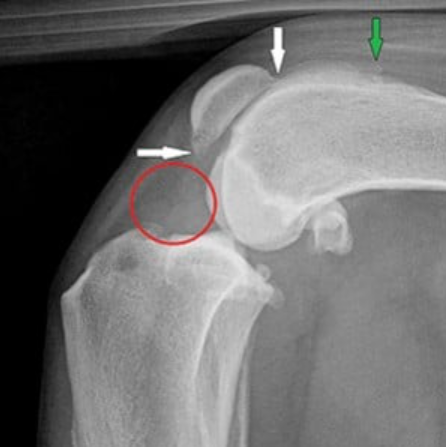
Osteoarthritis (white and green arrows) and joint fluid (red circle) indicative of cruciate rupture. Image credit: TVP
Treatment Options
Medical / Conservative Management
Best combined with TPLO surgery but may be used alone.
Success rates: Dogs <15 kg: 50–85%; Dogs >15 kg: 20–75%.
Partial tears respond better than complete ruptures, but may progress.
Weight loss is essential to reduce osteoarthritis risk.
Physical rehabilitation should be guided by your veterinarian; improper exercises may worsen the injury. Potential exercises include swimming, passive range of motion, “sit to stands,” toe pinches, and weight shifting.
Rough physical therapy timeline:
Weeks 1–4: Protection/rest
Weeks 5–8: Early strength training
Weeks 9–12: Intense strength training
Weeks 13–16: Return to normal activity
Pain control: Anti-inflammatories (e.g., Meloxicam) or neuropathic pain medications (e.g., Gabapentin) may be used. Overuse can lead to further damage if the dog becomes too active.
Knee braces/orthotics: Should be custom-engineered for the dog’s anatomy and biomechanics, rather than being a simple off-the-shelf support.
Better joint alignment
Reduced risk of pressure sores
More effective stabilization of the knee
Resources:
Surgical Repair (TPLO – Tibial Plateau Leveling Osteotomy)
Surgical Repair (TPLO – Tibial Plateau Leveling Osteotomy)
Gold standard for CCL rupture, especially in large dogs.
Success rate: 85–93%, with faster recovery than other methods.
Surgery alters the tibial plateau angle, inserts a plate for stability, and reduces osteoarthritis progression.
Recovery: Normal activities by ~4 months; full recovery ~6 months.
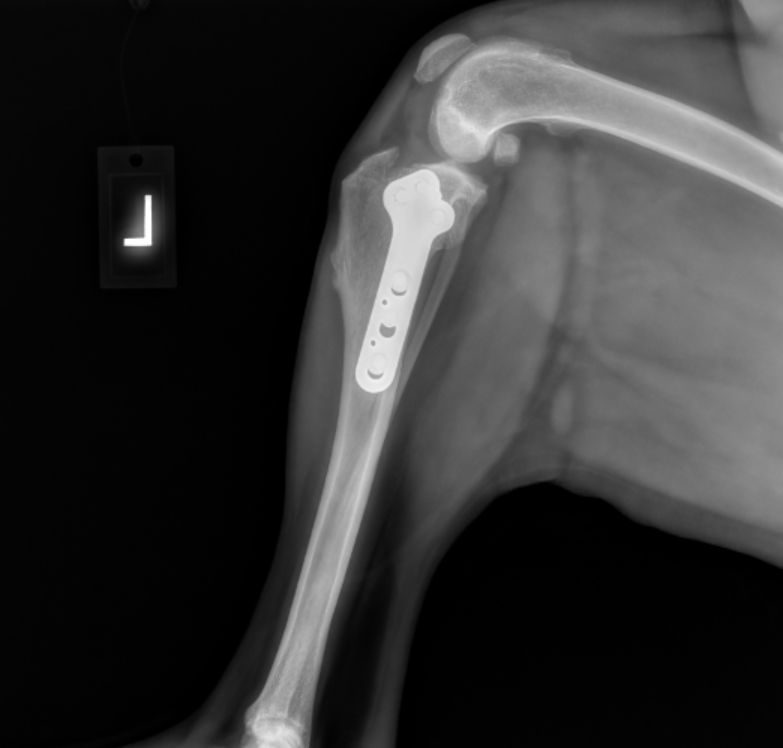
Image: Surgical repair of CCL tear using TPLO technique.
Joint Support – Essential for All Dogs
Whether you choose surgical or conservative management, all dogs should receive lifelong joint support to protect cartilage and reduce pain.
Omega-3 fatty acids:
EPA: 90 mg/kg/day
DHA: 20 mg/kg/day
Alternatively, 310 mg/kg^0.75/day of omega-3s
These doses have been shown to significantly improve pain and quality of life.
Joint supplements: Should include glucosamine, chondroitin, MSM, green-lipped mussel, etc.
Products like Aventi Omega-3 and Aventi Joint Complete contain clinically effective doses and comprehensive nutraceutical support.
Cartrophen Vet is a different form of joint support given as weekly injections under the skin for 4 weeks, followed by monthly maintenance injections.
It works by:
Protecting cartilage by slowing its breakdown
Stimulating cartilage repair and supporting joint health
Improving synovial (joint) fluid, allowing joints to move more smoothly
Reducing inflammation and pain
Improving blood supply to joint tissues
